Showing posts with label architecture. Show all posts

Saturday, December 10, 2011

Eames Love

Speaking of LA, have you seen this little film of Ice Cube talking about architecture in Los Angeles?  It's kind of fantastic.  He apparently studied architectural drafting before going into rap.  He speaks specifically about Charles and Ray Eames, and I love his observations.  "They was doing mash-ups before mash-ups even existed."
Check it out!  And for more of the Eameses, tune into PBS American Masters on the 19th of this month for a showing of the documentary Eames: The Architect and the Painter.  It looks utterly fantastic!

Thanks to Anna of Door Sixteen for bringing both of these lovely things to my attention!  She caught the doc at the IFC Center in New York and loved it, which makes me all the more excited to see it myself.

Thursday, March 10, 2011

land's end's glory days

It's with no small amount of heartbreak that I've been following along with the story of the demise of Land's End, the Long Island estate which supposedly inspired Daisy Buchanan's East Egg home.  To be fair, though I have a soft spot in my heart for The Great Gatsby, I view the demise of just about any residential grand dame with heartbreak.  And as it was designed by Stanford White, who was arguably the most famous American architect at the turn of the 20th Century (certainly in New York), this lady has a serious grand dame pedigree.

Built in 1911, Land's End played host to parties in the 20s and 30s which saw the likes of Winston Churchill, Ethel Barrymore, the Marx Brothers, and, of course, F. Scott Fitzgerald himself as guests.  It was clearly once an estate to be envied, and having only the photos of its decay to recommend it has been tragic.  To add insult to injury, the property has been purchased by a developer who plans to populate it with multi-million dollar McMansions.  Just what the world needs more of.

I'd love to see photos of the place from its heyday, but honestly, these few, from a publication issued sometime in the 70s or early 80s, are infinitely preferable to those of its decay.  So look, and enjoy, and try not to imagine the look on poor Jay Gatsby's face on the day of its demolition, standing in West Egg, watching it crumble.

Thursday, November 11, 2010

city hall station

 Can you guess how much I loved waking up to discover this post about the abandoned City Hall subway stop in New York?  If you guessed "So much," you are so right.

The station was built in 1904, but closed in 1945, primarily due to low ridership.  It isn't open to the public, but if you ride the 6 train past the end of the line, you'll get a firsthand view of this beauty as it loops around.  I know what train I'll be hoping on the next time I'm in the city.
Looking at these is making me think fondly of Neverwhere.  Photos by John-Paul Palescandolo.

via Adam

Monday, June 8, 2009

brief stop

Well, I have returned, triumphant, from my quest to conquer Rhode Island (see above photo, courtesy of the ever lovely Miss G). I wish I could say I have also returned to a somewhat regular blogging schedule, but sadly I am only pausing for a day and a half to do laundry and repack the car before departing again. More details on THAT once I'm settled.
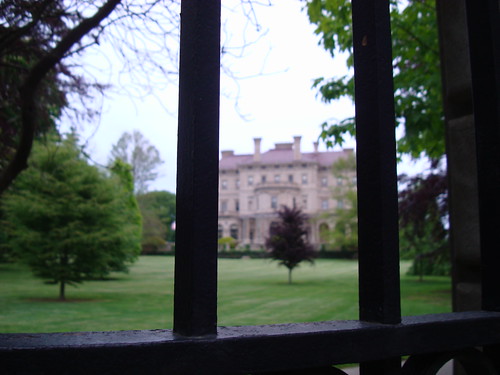
DSC02319
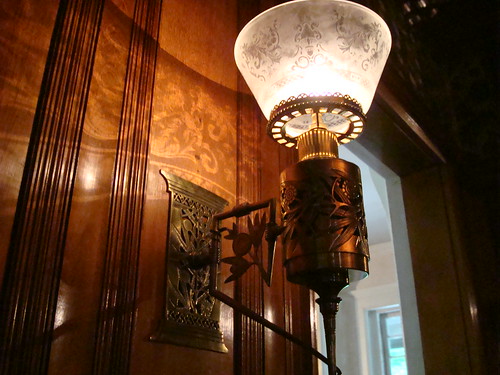
This most recent trip, was actually a summer school offered by the Victorian Society in America. I was in Newport, RI for a total of 10 days, about 8 of which were spent attending lectures, receptions, and exploring some of the fantastic buildings in that area of the country with architectural historian (and all-around great man) Richard Guy Wilson of the University of Virginia. I highly recommend it for fans of Victorian interiors and/or exteriors, although I should probably caution that Richard will gleefully walk your feet off: be warned.
DSC02645
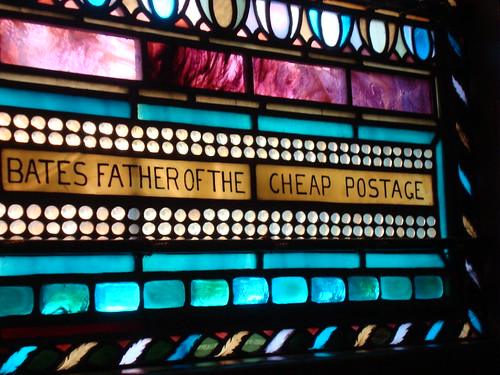
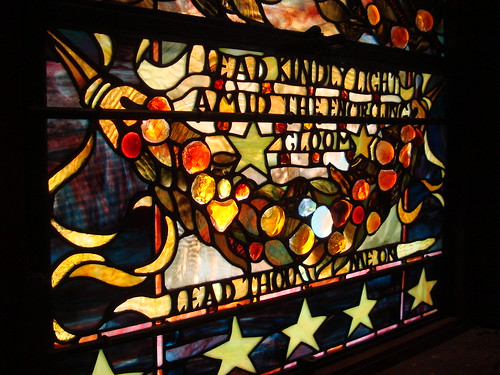
In addition to the homes we saw, we also toured several churches and municipal buildings. I must say, I came away with such an awe and appreciation for opalescent (or "favrile," if you're asking L.C. Tiffany) glass. My goodness, but I saw some gorgeous windows.
DSC02893
DSC03213
I took over 1,000 photos (which is nowhere near the amounts snapped by some of my classmates), of which 350 or so are on Facebook in two albums. I simply adored the coastal landscape we saw--it was cold, but gorgeous. That's all for now, I shall leave you with a short (30 second) video of waves crashing off the Cliff Walk, and hopefully return soon!

Rhode Island Waves from Kelly Williams on Vimeo.

Monday, March 9, 2009

sleeping porches

It's been so warm here the past few days (hard to believe only a week ago we had 6 inches of snow on the ground!) that I've been sleeping with my windows open, one of my favourite things to do. My room in the house I grew up in was over the garage and had two outside walls, meaning that it was freezing in the winter and boiling in the summer, so anything I could do to get a breeze in there, I did. As a result, I can't imagine not sleeping with my windows open when it's warm. The dogs love it because they can see, hear, and small everything while still lying comfortably on the bed, and I love the fresh air and the sounds of night. It makes me think I'm on a sleeping porch.
Sleeping porches had been common in the South for years (due to the great heat during the summer), but became popular elsewhere at the turn of the century, often in bungalow houses (most famously in the Gamble House). Health experts touted fresh air as a cure all for all sorts of afflictions, but most commonly for tuberculosis, which was the leading cause of death at the time.
photo source
Sleeping porches were usually on the second floor and often on corners of the house to take advantage of crosswinds.
A swinging bed--how lovely would this be in the breeze?
Unless otherwise noted, photos gleaned from Google searches. Some information found here.

Wednesday, March 4, 2009

proof my brother loves me

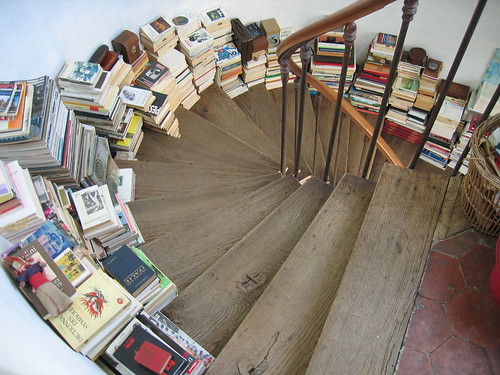
He may be half a world away (Buenos Ares, the wretch), but my brother still knows what I love to see. Of course, he reads this blog, so he's kind of got an in. Still, the combination of spiral staircases and books, books, books totally gets him a big hug when I get to BA in May. Here, for your drooling pleasure.

Thursday, December 11, 2008

london shop fronts

One of the things I liked best about London while I was there was the colorfulness of the shopfronts. Like bright, beautiful little dots on the urban landscape. As usual, I assumed I was the only one who took joy in such a random thing, and as usual I was wrong. London Shop Fronts is a blog devoted exclusively to: you guessed it. That there are other people out there as dorky as I am encourages my hope that I might someday reproduce.

via swissmiss

Monday, November 17, 2008

Culture Overflowing


Culture Overflowing, originally uploaded by David Serra.

Oh, oh, oh! Look at those books, the stairs! If I lived there, I think I'd find 100 excuses a day to use the stairs...

via Double Takes

Sunday, November 16, 2008

guaranty

Warning!: extreme dorking out ahead! Please secure your life jacket before continuing.
guaranty
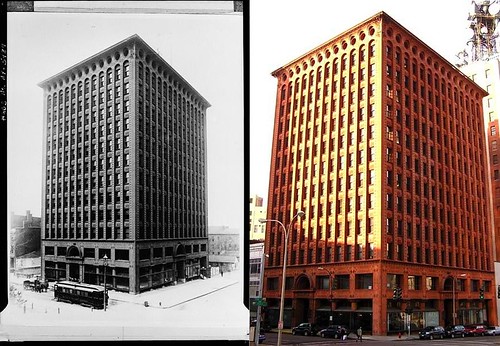
L: Circa 1900, R: 2006
An article in the New York Times today brought the city of Buffalo, NY to my attention. I knew it was there, of course, I'd just never had any reason to learn more. Boy, was I missing out. Turns out, after the completion of the Eerie Canal started to bring people in, it became a positive mecca for great Gilded Age architects: Henry Hobson Richardson, Frederick Law Olmsted (of Central Park fame), Louis Sullivan, and Daniel Burnham (of Chicago's Columbian Exposition in 1893). I'd really love to prattle on about all out them, but this is a blog, not an architectural history class, so I'll stick to one: Louis Sullivan, and his Guaranty building.In 1894, a Buffalo businessman commissioned Sullivan's firm in the construction of a new office building. After he died suddenly, the Guaranty Construction Company of Chicago purchased it, followed by the Prudential Insurance Company. Both "Guaranty" and "Prudential" are on the building, so you'll hear it referred to by both names.The exterior is covered in gorgeous terra cotta depicting art nouveauish foliage and geometric patterns.
Look at that scrollwork! Love!
Let's take a look at the interior!So it turns out that I get as freakishly excited about old iron elevators as I do doors. Who knew? Aren't they fantastic?
If you're interested in learning more about the Guaranty building, other buildings, or historic Buffalo architecture on the whole, check out Buffalo Architecture and History (h/t to historic preservationist/jewelry designer/fellow dec arts student Amy Poff). I pulled most of my images from them.

For more on Gilded Age architects, I highly recommend reading Devil in the White City by Erik Larson, about the Chicago World's Fair, the men who put it together, and a rather nefarious individual who took advantage of it. It's nonfiction that reads like fiction. Trust me, I hate nonfiction.

There. Done. It is now safe to remove your jackets. I don't do too many of these because I worry about boring people, so if you enjoyed this little discovery as much as I did, let me know!

Monday, November 3, 2008

FLW

My whole life, I've known of a couple Frank Lloyd Wright houses in this area, overlooking the Potomac. They were mystical places in my mind, surrounded by trees, shrouded from view. Recently, I visited the Pope-Leighey House (which used to be in Falls Church), but I've never seen a FLW house in situ. If the house in this article is any example, they're breathtaking.Gorgeous (and yeah, okay, the Papa Bear chair helps). via ATDC

Sunday, October 5, 2008

colorful cornice

I love this room. Such a clever way to find room for books. From today's Times.
"The original owner had asked Mr. Ford for expanses of glass and lots of space for books — seemingly irreconcilable requests. The architect hit on the idea of the overhead shelves; the books form a kind of colorful cornice. 'We took our books out of boxes and put them up, and the whole room came together,' Mr. Allen said."

Monday, September 15, 2008

Adams love, love, love

So I've been spending a lot of time at the Library of Congress lately. It's an incredible resource, not to mention a beautiful place. The LOC has three buildings: the Jefferson, the Adams, and the Madison. The Jefferson is the oldest (1897) and most overtly impressive of the three. With the Great Hall and the gorgeous dome in the Main Reading Room, it is by far the tourist hotspot. The Madison is the most recent of the three, it opened in 1976. The building looks rather boxy and plain until you stand directly in front of the main door.

But my favourite, oh, my favourite is the Adams Building (see top photo). Completed in 1939, this baby is aaaaaaall Deco.
from Dan_DCabove two images from pixelmasseuse (who's also got many other great shots of DC and area events)
Unfortunately for me, the Main Reading Room is where all of my resources are located these days, so I have to make special trips to the Adams. I don't mind, though. It is so worth it.

Images, except for those marked otherwise, were found via the LOC Prints and Photographs catalog. Photographer credit was not given.

Monday, August 4, 2008

Whalehead Club

Whalehead Club
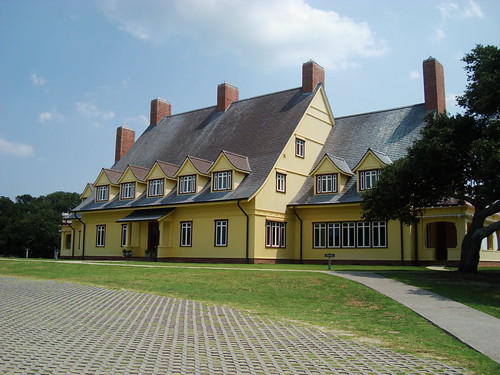
Hello, I'm back! I'm still (reluctantly) recovering from my vacation, but I've just been dying to talk about the Whalehead Club, so you'll have to excuse the long informative post. Lovers of Art Nouveau, take note! Located in Corolla, NC, it's just north of my family's annual beach retreat. I am astonished that I'd managed to go so many years without knowing of the treasures this place holds.
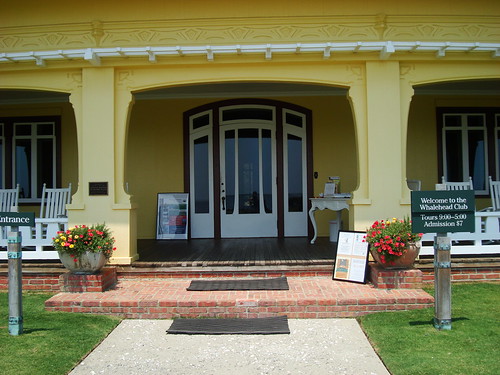
front entrance
By the time this house, originally called Corolla Island, was built by Mr. and Mrs. Edward Collings Knight, Jr. in 1922, Art Nouveau had been out of fashion for 20 years. The Knights must have loved it, however, as its graceful patterns are present throughout the house. The place is amazingly intact considering that the Knights passed away in the 40s and the house was subsequently sold (for a pittance, at that).
lilies
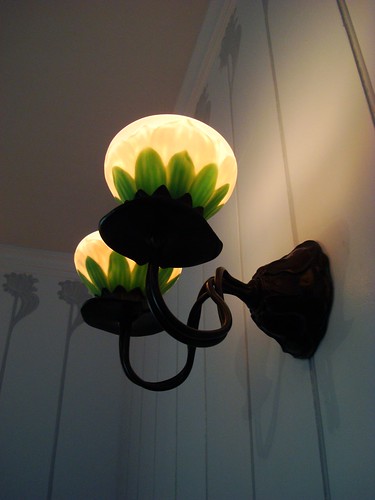
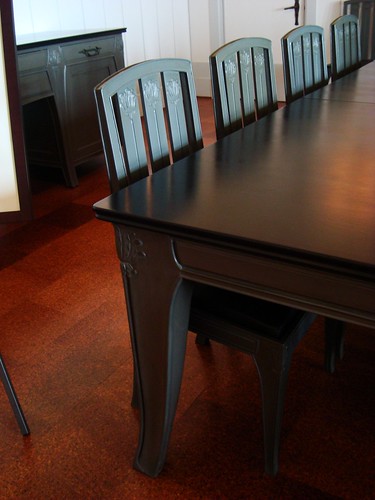
The exterior architectural details, many of which predate the house and were probably taken from a previous residence of Mrs. Knight, are in great condition, to say nothing of the amazing interior. The glass and bronze of the light fixtures in the dining room and entry are Tiffany and original. Most of the dining room furniture is original, as well (only one of the below chairs is, the rest are reproductions).
nouveau dining
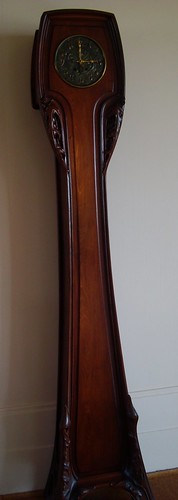
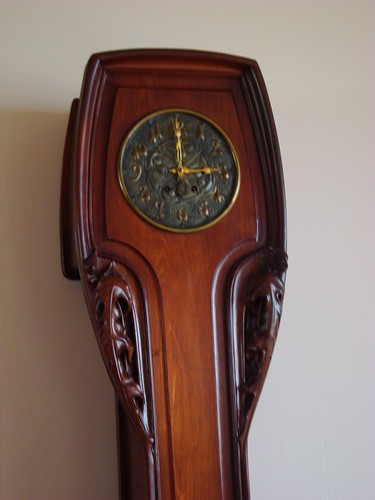
But oh, oh, just look at this clock! I apologize for the shoddy photo quality, I couldn't use a flash. This, as well as several other pieces from the house's library, was design by Louis Majorelle, a fantastic Art Nouveau cabinet maker.
stand talldetail top

Here are all of my photos from the Whalehead Club. There are lots more on Flickr, as well. Hope you enjoyed my burst of nerdiness!

Thursday, July 24, 2008

new Beijing

The family we visited with.
When I was in China in 2005, our group toured some of old Beijing in rickshaws. We visited with a family at a siheyuan, or courtyard house, that had been in their family for generations and generations; the house itself dated back several hundred years. They no longer had the resources to keep it up, so the side chambers which had belonged to other family members were closed up and falling apart. Despite the lovliness of the visit, it was so incredibly sad to see that home in that state.
Not my photo, but much as I recall the state of hutong housing.
That family was a lucky one, however. Under Mao, many siheyuans were redeveloped into group housing lacking the basic amenities, and many remain that way, housing four families in spaces meant for one. These have no indoor plumbing, just centrally located public bathrooms (which leave much to be desired, believe me). In the years leading up to next month's Olympics, the Chinese government razed old Beijing hutong neighborhoods left and right in an effort to spruce up their city.
A home built in the Qing Dynasty, partially razed to make room for a new Transportation Ministry Building.
The New York Times has an article today about foreigners buying and renovating old siheyuans in Beijing, and the results are more Chinese than Beijing's newest building projects.Even with the modern updates, the homes retain the peaceful, closed-in feel of traditional siheyuan living, down to the interiors and detailing.

I love China and traditional Chinese art and architecture. It's good to see that there are people trying to maintain those traditions, since the government is plainly uninterested in doing so.

All photos save the top one by Shiho Fukada and taken from these two articles.